What your hearing test results “mean” comes down to three things: how loud sounds need to be before you hear them, which pitches are affected, and how that fits into a WHO degree of hearing loss scale.
Understanding your audiogram
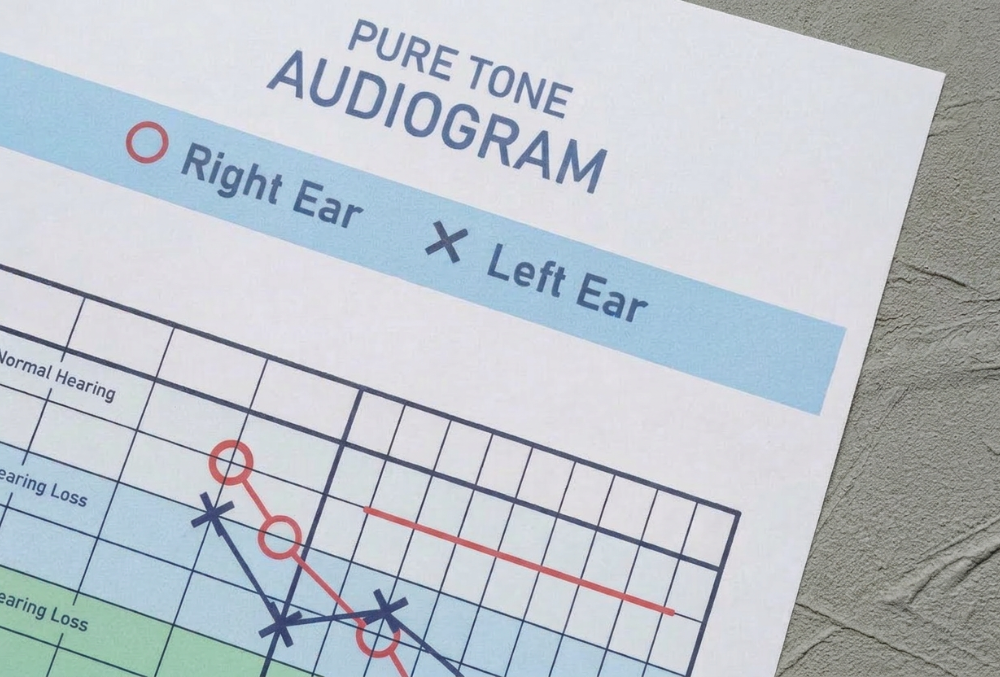
An audiogram is a graph showing the softest sounds you can hear at different pitches.
- The horizontal axis shows pitch (frequency) in Hertz (Hz), from low (bass) to high (treble); low pitch to high pitch (left to right)
- The vertical axis shows loudness in decibels (dB HL); the further down the mark, the louder the sound had to be for you to hear it.
- “O” usually marks your right ear, “X” your left ear or Red symbols for the right ear (R-R) and Blue symbols for the left ear (B-L)
In everyday terms, marks near the top (0–20 dB) mean normal hearing for that pitch, while marks further down show reduced sensitivity and possible hearing difficulty; the greater the number in dB, the poorer the hearing.
WHO classification: your average thresholds
To give an overall “grade” of hearing, professionals often calculate a pure‑tone average (PTA).
- They take your thresholds at key speech pitches (usually 500, 1000, 2000, 4000 Hz) for each ear, add them, then divide by four.
- The better ear’s PTA is then compared with WHO categories to describe your degree of hearing loss.
A commonly used WHO grading (better ear, average at 0.5–4 kHz) is:
| WHO grade (better ear) | PTA range (dB HL) | Everyday meaning |
| Normal / no impairment | 0–20 | Hears whispers and soft speech easily |
| Mild / slight | 21–34 or 26–40 (older scales) | May miss soft speech, children, speech in noise |
| Moderate | 35–49 or 41–60 | Needs louder speech, often asks for repeats |
| Moderately severe | 50–64 | Very hard to follow conversation without effort |
| Severe | 65–80 | Usually hears only loud voice at close range |
| Profound | ≥81 | May not hear even shouted speech; relies on visual cues |
Your report may use slightly different cut‑offs (for example, grouping “moderately severe” into “moderate–severe”), but the idea is the same: the higher the PTA (Pure Tone Audiometry) average, the more impact on everyday communication.
The speech banana: what sounds you miss
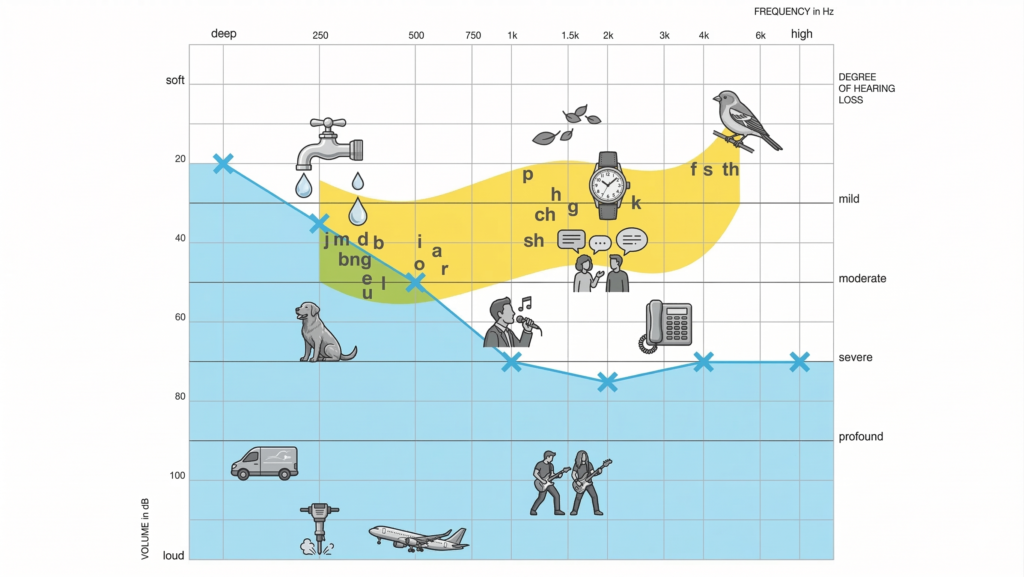
On many audiograms you’ll see a shaded, banana‑shaped area called the speech banana.
- It represents where most everyday speech sounds fall in terms of pitch and loudness.
- Vowels (a, e, i, o, u) are mostly lower‑pitch and louder; they sit more to the left and higher on the chart.
- Many consonants (s, f, sh, th, k) are higher‑pitch and softer, placed to the right and slightly lower.
If your thresholds (X’s and O’s) are above the banana, you should hear most speech clearly; if they fall inside or below parts of it, you may miss those sounds.
Example: someone with high‑frequency loss might still hear vowels but miss “s”, “f” and “th,” so words sound unclear or “muffled,” even if they seem loud enough.
What to expect at each degree of loss
Linking WHO grades and the speech banana helps explain day‑to‑day listening.
- Normal / near‑normal: You catch soft voices and whispers, and speech is usually clear even in quiet group conversations.
- Mild loss: You often hear that someone is talking but may miss parts of words, especially in noise or when the talker is soft‑spoken or at a distance.
- Moderate loss: You need people to speak up or face you; phone calls, TV at “normal” volume, and conversations in restaurants become challenging.
- Moderately severe to severe loss: You may depend on lip‑reading; without hearing aids, it’s hard to follow a normal conversation, even in quiet.
- Profound loss: You typically rely on powerful hearing aids, cochlear implants, and/or visual communication methods to understand speech.
Your audiologist will also describe the shape of your audiogram (for example “high‑frequency sloping” or “flat”), which helps explain why some situations are harder than others and which sounds are most affected.
Putting your report into action
Your hearing test is more than numbers; it guides what support will help you hear your life again.
- Mild to moderate loss often benefits from appropriately fitted hearing aids and communication strategies (better seating, facing the talker, reducing background noise).
- More severe losses may require stronger amplification, assistive listening devices, or implantable solutions, plus regular monitoring.
If your results mention WHO grade, PTA, or show a speech banana, don’t hesitate to ask your audiologist to walk through how your own symbols line up with that shaded area. Seeing which parts of speech fall “above” your thresholds makes your hearing test much easier to understand.
Ready to understand your own results?
Schedule a comprehensive hearing test with Active Hearing Center so an audiologist can explain your audiogram, WHO classification, and options in clear, simple terms.Prefer to start from home? Take our quick, convenient online hearing test to get an initial snapshot of your hearing and see if further in‑clinic testing is recommended.